Southern Flying Squirrel
Glaucomys volans
On This Page▾
🌍 Overview
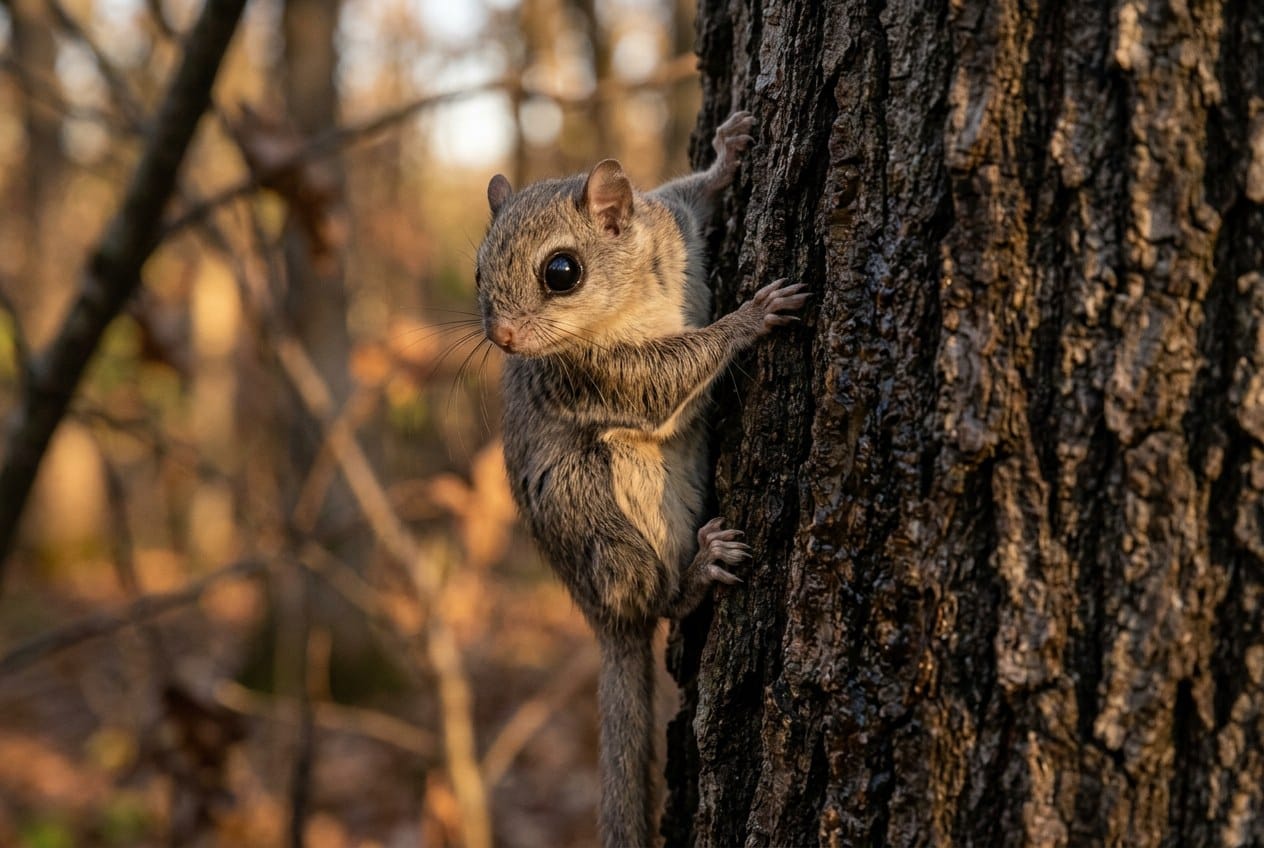
The Southern flying squirrel is a small nocturnal rodent native to the deciduous forests of eastern North America, gliding between trees on a furred membrane called a patagium stretched between its wrists and ankles. Despite the superficial resemblance and identical gliding strategy, flying squirrels are true rodents and are not closely related to sugar gliders, which are marsupials, a striking case of two unrelated animals independently evolving the same solution. Flying squirrels are deeply social and live in family groups, huddling together for warmth through winter.
📋 Quick Facts
Native Range
Eastern North America
Natural Habitat
Deciduous and mixed forest
Adult Size
8-10 inches (20-25 cm) total length including tail; 2-3 oz
Wild Diet
Nuts, seeds, fruit, fungi, insects, and occasionally bird eggs or nestlings
Wild Lifespan
3-6 years in the wild (sources vary); commonly around 10 years in captivity, with documented individuals living past 19
Conservation Status
Least Concern (IUCN)
📜 History
Linnaeus described the animal in 1758 as Mus volans, and English long borrowed a Native American name for it, the assapan. Its recent trade history is less genteel. Florida wildlife officers opened an investigation on January 15, 2019 after a tip about people trapping flying squirrels in rural Marion County, and uncovered a ring that had set as many as 10,000 traps and pushed thousands of wild-caught animals through a licensed dealer in Bushnell who logged them as captive-bred. Buyers from South Korea collected the squirrels, drove them to Chicago and exported them, and the dealer took in $213,800 between November 2017 and April 2020. Seven people were charged.
⚖️ Compare
Southern Flying Squirrel
Human
Adult Size
8-10 inches (20-25 cm) total length including tail; 2-3 oz
5-6 feet (150-185 cm); ~135-200 lbs
Wild Lifespan
3-6 years in the wild (sources vary); commonly around 10 years in captivity, with documented individuals living past 19
~73 years (global average)
Wild Diet
Nuts, seeds, fruit, fungi, insects, and occasionally bird eggs or nestlings
Omnivorous - eats just about anything
Native Range
Eastern North America
Global - originated in Africa roughly 300,000 years ago
Natural Habitat
Deciduous and mixed forest
Everywhere from arctic tundra to tropical megacities
Conservation Status
Least Concern (IUCN)
Least Concern (8+ billion and counting)
🧠 Test Yourself
What's the Southern Flying Squirrel's native range?
🤩 Fun Facts
🐿️ Two Gliders, No Relation
Flying squirrels and sugar gliders glide the exact same way, a furred membrane stretched from wrist to ankle, and evolved that trick completely independently. One is a true rodent, the other a marsupial, and their common ancestor never had anything like it. Gliding membranes evolved convergently across several unrelated mammal groups, including rodents, bats, and colugos, each arriving at a similar structure through a different genetic path.
⚖️ Where it is legal
43 US jurisdictions restrict this species, from outright bans to permits. Every one quotes the rule it comes from.
Subscribe - it's free
New animal facts and care guides straight to your inbox. No spam. 🐾
📰 Deep Dive
🐿️ How Much Does a Pet Flying Squirrel Really Cost?
🐿️ How to Handle a Flying Squirrel (Bonding Starts in the Pouch, Not Your Hands)
🐿️ Common Flying Squirrel Health Issues (Diet Drives Almost Everything)
🐿️ Flying Squirrel Cage Setup: Tall, Not Wide
🐿️ Flying Squirrel Feeding: Diet, Schedule, and the Calcium Ratio That Prevents Paralysis
🐿️ Flying Squirrel Enrichment: A Rodent That Solved the Same Problem
🩺 Health and More
🤓 Did You Know?
Flying squirrels are true rodents, not marsupials, so despite gliding the same way on the same kind of wrist-to-ankle membrane, they aren't closely related to sugar gliders at all. It's convergent evolution: two unrelated animals independently landing on the same solution.
Explore More