Tarantula
Invertebrates
The misunderstood gentle giant of the spider world, a surprisingly low-maintenance pet!
On This Page▾
🤓 Did you know? Tarantulas can live extraordinarily long lives. Females of some species (like the Mexican Red Knee) can live 25 to 30 years in captivity, while males typically live only 5 to 7 years. A female tarantula may outlive your dog.

🗓️ The first week
The numbers a new owner needs in the first week, each from the article it links to. Rows with no link come from the encyclopedia.
- Enclosure
- Horizontal, wider than tall, to limit fall risk. A reasonable adult minimum is around 20x10x10 inches, roughly a 10-gallon, sized to about three times the tarantula's leg span. Keep overall height under about 12 inches.Setup guide →
- Substrate
- At least 3 inches of coconut fiber, peat, or organic pesticide-free soil, filling roughly half to two-thirds of the enclosure.Setup guide →
- Lid
- A secure lid, but never mesh, a tarantula's feet can get caught in it and cause real injury. Acrylic with drilled ventilation holes is the better choice.Setup guide →
- Humidity
- Sources genuinely disagree: some recommend a moderate 40 to 60% for dry-adapted species, others suggest 65 to 75%. A reliable water dish plus lightly moistened substrate is more consistent than heavy misting either way.Setup guide →
- Housing
- One tarantula per enclosure. Most species are solitary and cannibalistic, and cohabitation isn't workable regardless of enclosure size.Setup guide →
- Feeding schedule
- Slings every 2 to 3 days, juveniles roughly every week to two weeks (sources disagree on the exact number), adults every 1 to 2 weeks, sometimes far less for a slow-metabolism species.Feeding guide →
- Not eating
- Usually not an emergency. A plump, active spider refusing food for weeks is typically just in premolt. For juveniles specifically, refusing food for more than 6 to 8 weeks alongside weight loss or lethargy is worth a vet consult.Feeding guide →
- Handling
- Mostly, no. Best kept as a look, don't touch pet: a fall can rupture the abdomen and is often fatal, and a hand, shoulder, or couch cushion is enough height for that.Handling guide →
- Budget
- $25 to $100 for the spider (common beginner species), $70 to $300 for a complete setup, and $5 to $15 a month after that.Cost guide →
- Adult size
- 2 to 12 inch leg span, depending on species.
- Lifespan
- 15 to 20 years or more for a female Chilean rose hair, typically 4 to 7 for a male. A female is a long-term commitment, though the ongoing budget stays very small the whole time.Cost guide →
- Power outage
- A non-event for most tarantulas at home; they don't need supplemental heat in a typical room and can go without food far longer than most pets. The real risk in this corner of pet keeping is in a car or a shipping box, not a home outage.Emergency plan →
- Quarantine
- At least three months apart from any other invertebrate, with its own tools. Long enough for mites, mold and an import's nematodes to show while the setup is still simple.Invertebrate Housekeeping →
- Cleaning and escapes
- Uneaten prey out within 24 hours, remains weekly, substrate every 6 to 12 months or at the first mold. An escapee hides low, dark and warm: search at night with a flashlight and bait with water.Invertebrate Housekeeping →
🚨 Emergency card
Check the water dish and humidity first, then act on these today. Vet care for tarantulas is limited.
- A shriveled, wrinkled abdomen with lethargy or legs curling tightly under the body (dehydration)
- A molt that looks stuck or incomplete
- A ruptured abdomen or hemolymph visibly leaking from an injury
- Refusing food for more than a month, especially alongside dehydration signs
Prevention matters more than treatment. A shallow water dish and correct humidity prevent most dehydration; never disturb, handle, or feed a molting tarantula.
📰 Where to go next
How Much Does a Tarantula Really Cost?
$25 to $100 for the spider, $70 to $300 for setup, and why the ongoing budget stays small for decades.
Should You Handle a Tarantula? Almost Always, No
Why the answer is almost always no, the real fall risk, and New World versus Old World defenses.
Common Tarantula Health Issues (Prevention Matters More Than Treatment)
Dehydration, stuck molts, injury, and the difference between normal fasting and a real problem.
Tarantula Enclosure Setup: Shape, Substrate, and a Humidity Debate
Enclosure shape and size, substrate depth, the humidity debate, and why mesh lids are out.
Stick Insect Feeding: Bramble in a Jar, the Right Plant for the Species, and Water That Cannot Drown a Nymph
Bramble for nearly every species, the plant list by species, cuttings in a covered jar, washed leaves, and an evening mist to drink.
Tarantula Enrichment: The Spider Sat Still in Both Enclosures
What the research on enclosure complexity actually found, and what it didn't.
Are Tarantulas Legal? The Species Question Most States Never Ask
The species question most states never ask, and where a specific tarantula is restricted regardless of the genus.
🛒 What to buy
Prices and the reasoning behind each item are in How Much Does a Tarantula Really Cost?.
❓ Frequently Asked Questions
How much does a tarantula cost upfront?
The spider itself runs $25 to $100 for common beginner species, a Chilean rose hair or curly hair typically lands at $20 to $50. Add the enclosure, substrate, hide, decor, and a water dish, and most first-time setups land in the $70 to $300 range before the spider itself.
What size enclosure does a pet tarantula need?
About 20 by 10 by 10 inches for an adult, roughly a 10-gallon, sized to around three times the leg span. Keep it low, under about 12 inches tall, since a fall is a genuine danger for most tarantulas.
Can you hold a tarantula?
Mostly, no. Most tarantulas, including the Chilean rose hair, are best kept as strictly look, don't touch pets, since a fall can be fatal to the spider and its defenses can hurt you.
📚 Encyclopedia
Tarantula
Various
Subscribe - it's free
New care guides straight to your inbox. No spam. 🐾
🖨️ Printable Guide
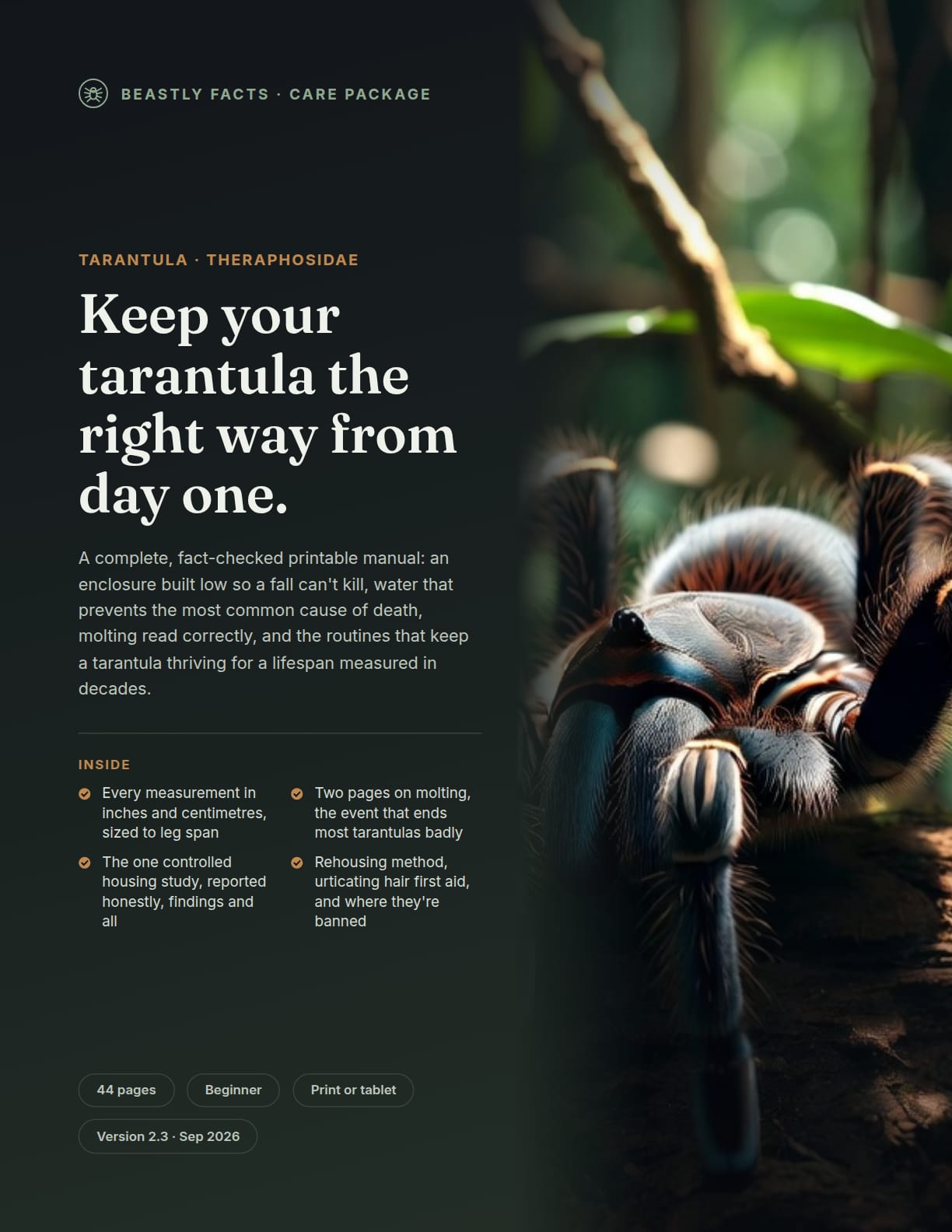
Tarantula Care Package
44 pages · PDF · $8.99
⚖️ Legal Guide
📰 Deep Dive
🕷️ How Much Does a Tarantula Really Cost?
🕷️ Should You Handle a Tarantula? Almost Always, No
🕷️ Common Tarantula Health Issues (Prevention Matters More Than Treatment)
🕷️ Tarantula Enclosure Setup: Shape, Substrate, and a Humidity Debate
🕷️ Tarantula Feeding: Schedule, Diet, and Why They Stop Eating
🕷️ Tarantula Enrichment: The Spider Sat Still in Both Enclosures
🩺 Health and More
🕷️ Invertebrate Molting 101: What's Normal, Species by Species
☠️ Household Pesticides and Your Invertebrate Pet: The Hidden Hazard
📦 Rehousing an Invertebrate: Method, Timing, and Urticating Hair First Aid
🕷️ Invertebrate Housekeeping: Quarantining a New Arrival, Cleaning the Enclosure, and Finding an Escapee
📦 Invertebrate Emergency Plan: Power Outages, Travel, and Shipping
🔑 Four Pets With One Rule Each Worth Knowing First