Zebra Danio
Danio rerio
On This Page▾
🌍 Overview
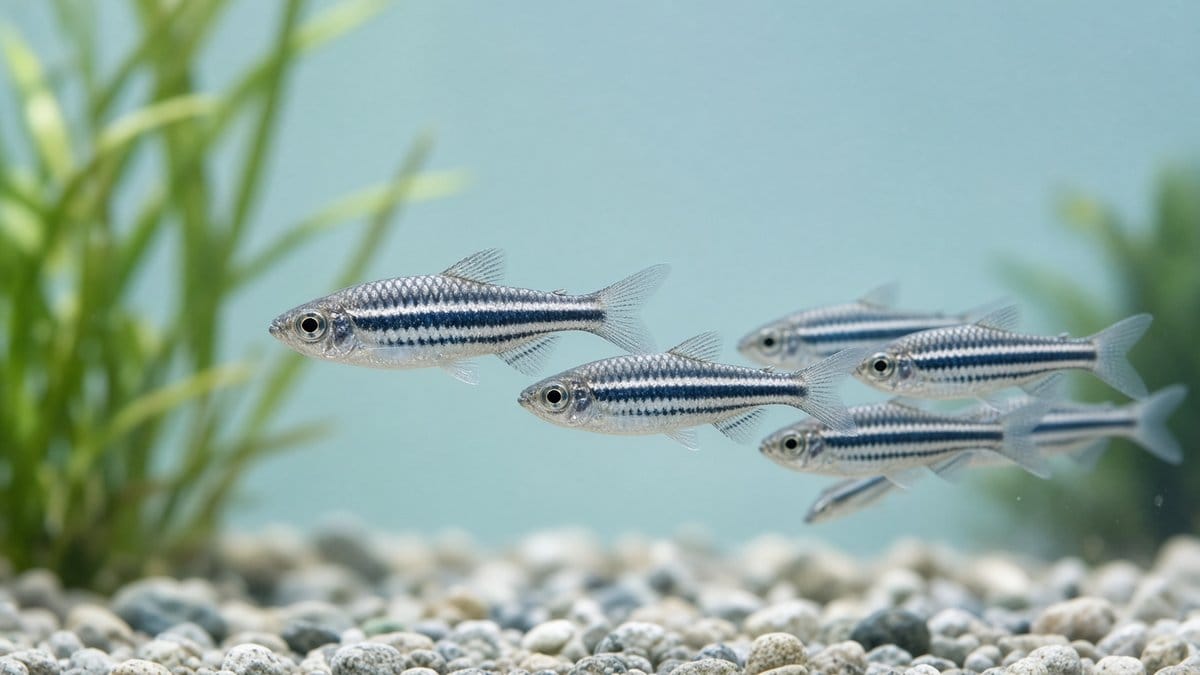
The zebra danio is a small, fast-swimming schooling fish native to the shallow streams, ditches, and monsoon-flooded rice paddies of South Asia. Unlike livebearing guppies and mollies, danios are egg-scatterers: a spawning pair releases eggs into open water or fine-leaved plants, with no nest built and no parental care afterward. Outside the aquarium hobby, the zebra danio is best known as zebrafish, the most widely used non-mammalian vertebrate model organism in developmental biology and genetics research. Its embryos develop transparently outside the mother's body, and roughly 70 percent of human genes have a working counterpart in its genome, a combination that has made it a mainstay of labs studying development, disease, and drug discovery since the 1990s.
📋 Quick Facts
Native Range
South Asia (Ganges and Brahmaputra river basins of India, Bangladesh, and Nepal)
Natural Habitat
Shallow, slow-moving streams and ditches, with seasonal migration into monsoon-flooded rice paddies and marginal pools to spawn
Adult Size
1.5-2.5 inches (4-6 cm); occasionally to 3 inches (7.5 cm) in captivity
Wild Diet
Zooplankton, aquatic and terrestrial insects, and mosquito larvae, taken from open water and the surface
Wild Lifespan
Around 1 year in the wild; 3.5 years average in captivity, with documented individuals living to 5.5 years
Conservation Status
Least Concern (IUCN)
📜 History
Francis Hamilton, a Scottish physician working under the East India Company, described the fish in 1822 from specimens collected in Bihar, calling it a beautiful fish with blue and silver stripes along each side. Its second life began at the University of Oregon, where George Streisinger spent the 1970s adapting a pet shop fish to genetics work. In 1981 he published a paper in Nature reporting the first large-scale production of genetically uniform clones of a vertebrate. Early laboratory strains were founded with animals bought from the pet trade or collected in the wild, and Streisinger's methods went on to spread to more than 500 labs in 32 countries.
⚖️ Compare
Zebra Danio
Human
Adult Size
1.5-2.5 inches (4-6 cm); occasionally to 3 inches (7.5 cm) in captivity
5-6 feet (150-185 cm); ~135-200 lbs
Wild Lifespan
Around 1 year in the wild; 3.5 years average in captivity, with documented individuals living to 5.5 years
~73 years (global average)
Wild Diet
Zooplankton, aquatic and terrestrial insects, and mosquito larvae, taken from open water and the surface
Omnivorous - eats just about anything
Native Range
South Asia (Ganges and Brahmaputra river basins of India, Bangladesh, and Nepal)
Global - originated in Africa roughly 300,000 years ago
Natural Habitat
Shallow, slow-moving streams and ditches, with seasonal migration into monsoon-flooded rice paddies and marginal pools to spawn
Everywhere from arctic tundra to tropical megacities
Conservation Status
Least Concern (IUCN)
Least Concern (8+ billion and counting)
🧠 Test Yourself
What's the Zebra Danio's native range?
🤩 Fun Facts
🐠 The Fish Behind GloFish
The fluorescent GloFish sold in pet stores are zebra danios with a jellyfish-derived fluorescent gene added to their genome. That gene wasn't developed to be sold as a pet at all, researchers at the National University of Singapore originally built it to create a fish that would glow in the presence of water pollutants, and it only later got licensed for the aquarium trade.
📖 Care Guide
Zebra Danio Care Guide
The tireless little striped torpedo that never stops commuting!
Subscribe - it's free
New animal facts and care guides straight to your inbox. No spam. 🐾
📰 Deep Dive
🐠 How Much Does Zebra Danio Ownership Really Cost?
🐠 Zebra Danio Handling: Why the Easiest Fish to Keep Is One of the Hardest to Catch
🐠 Common Zebra Danio Health Issues, Backed by the Best-Documented Fish Disease Data in the Hobby
🐠 Zebra Danio Tank Setup: The Rare Community Fish That Might Not Need a Heater
🐠 Zebra Danio Feeding: Diet, Schedule, and the Live Food That Can Trigger an Accidental Spawn
🐠 Zebra Danio Enrichment: The Most Studied Fish in the World Lives in a Bare Box
🩺 Health and More
🐠 Aquarium Power Outages, Transport, and Moving Your Fish: The Complete Plan
🦠 How to Cycle a Fish Tank, Start to Finish: Fishless and Fish-In
🧽 Aquarium Filtration: How It Actually Works and How to Maintain It
🪣 Aquarium Water Changes: How Much, How Often, and What the Number Is For
🐟 Aquarium Stocking and Tankmates: How Many Fish, and Which Ones Go Together
🧪 Freshwater pH, GH, and KH: Why Chasing a Number Backfires
🩺 Fish Quarantine and Treatment: The Hospital Tank Guide
🩹 Treating Ich: Heat, Salt or Medication, and the Temperature Ceiling That Decides
🩺 How to Tell If Your Fish Is Sick: Waste, Behavior, and Body Signs
🧊 Cooling an Aquarium Without a Chiller
🐠 Four Fish, Four Completely Different Difficulty Levels
🤓 Did You Know?
Zebra danios, known to scientists as zebrafish, are the most widely used non-mammalian vertebrate model organism in developmental biology and genetics research. Their embryos develop transparently outside the mother's body within hours of fertilization, letting researchers watch organs form in real time, and roughly 70 percent of human genes have a working counterpart in the zebrafish genome, sequenced in full in 2013. That same genetic malleability is also how GloFish, the first genetically modified animal ever sold as a pet, came to exist: they're fluorescent zebra danios.
Explore More