Ferret Cage Setup (And Why the Cage Is Only Half the Job)
On This Page▾

A ferret sleeps in its cage and lives in your house. It needs a roomy multi-level cage in a cool room, and it needs a ferret-proofed space to run in for hours every day. First-time owners usually get the cage right and underestimate the room.
Cage Size
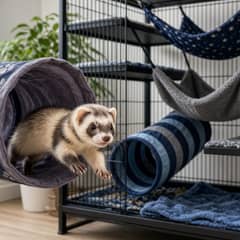
Buy a multi-level wire cage with solid floors.
- Size. At least 24 inches long by 24 inches wide by 36 inches tall for one ferret. A floor closer to 3 feet by 3 feet is better, and a pair needs more again.
- Bar spacing. One inch or less.
- Floors and ramps. Solid. Bare wire and mesh hurt feet and can catch a claw.
- Levels. Several, joined by ramps, so the cage is a route to explore and not only a bed.
A double-unit cage such as the Critter Nation (sold as the Ferret Nation for this species) has solid levels and a covered ramp.
Where the Cage Goes: Temperature and Light
Ferrets cannot sweat, which makes them highly prone to heat stroke. Cold is far less of a problem.
- Keep the room at 65 to 75°F.
- Do not let it pass 80°F. At 90°F a ferret is in danger.
- Keep the cage out of direct sunlight and away from heaters and sunny windows.
- Add no heat lamp, heat mat or other heat source.
A normal day and night cycle matters too. Long hours of artificial light are one of the factors linked to adrenal disease, the hormone problem behind the hair loss that starts at a ferret's tail. Let the room go dark at night, and give the ferret a dark, quiet place to sleep.
Most exotic pets need help staying warm. A ferret is the reverse: it has no sweat glands, so its setup has no heat lamp, no heat mat and no basking spot, and the summer plan matters more than the winter one.
Bedding and Litter
Sleeping. Hammocks are a ferret's favorite place to sleep. Hang washable fabric hammocks and sleep sacks on the upper levels, and keep a spare set so one can be in the wash.
Litter. Put a corner litter box on the level farthest from the food and the beds. Fill it with a pelleted litter, paper or wood.
Do not use:
- Clumping cat litter, which can cause breathing problems in ferrets
- Scented litter
- Sand or silica cat litter
- Cedar or pine shavings, which irritate the airways
Setting Up the Cage, in Order
- Pick the room first: cool, out of direct sun, and one you can ferret-proof.
- Build the cage and check that every door latches. Ferrets test latches.
- Hang the hammocks and sleep sacks on the upper levels.
- Put the litter box in a lower corner, away from the beds.
- Put the food bowl and water on a different level from the litter box.
- Set a thermometer near the cage, at cage height.
- Ferret-proof the play room before the ferret comes home, using the list below.
Once the ferret is in, scoop the litter box every day and wash the hammocks and bedding every week. That routine does more for the musky smell than bathing the ferret does.
Ferret-Proofing the Play Room
A cage alone does not meet a ferret's needs. It needs at least 2 to 4 hours of play outside the cage every day, in a space where it cannot get into trouble. Ferrets chew and swallow rubber, foam and soft plastic, and a swallowed piece can block the gut, so proofing the room is health care as much as tidiness.
Work through the room at floor level:
- Block every opening that leads somewhere you cannot reach. That means gaps under and behind cabinets, holes around pipes, and vents. Treat any gap wider than about one inch as an open door.
- Block the inside of couches and chairs. Ferrets climb into the frame from underneath.
- Shut closets and block off speakers.
- Pick up everything made of rubber, foam or soft plastic. Shoe insoles, earplugs, remote buttons, foam toys and rubber bands all count.
- Cover or lift electrical cords. Cord protector tubing closes off the ones you cannot move.
- Stay in the room. Out-of-cage time is supervised time.
Assume your ferret will find the one gap you missed, and check the room again after the first few sessions.
One Ferret or Two
Ferrets can be kept singly or in a small group. Animal welfare charities recommend a pair or small group for company. Some vets prefer one ferret per cage to avoid the stress of group living, and groups are best kept to three or four at most. A single ferret can do well, but it depends on you for all of its play and company. If you want two, plan the cage size for two from the start.
A Cool Room and a Safe Floor
The cage is the easy purchase. The parts that protect a ferret are the ones that cost little: a room that stays cool in summer, lights that go off at night, and a floor with nothing on it to swallow. Get those right before the ferret arrives, and the cage only has to be a good place to sleep.
Sources & Further Reading
Last reviewed 16 Nov 2026 · 5 sources
- Merck Veterinary Manual: Providing a Home for a Ferret; Management of Ferrets
- PetMD: Ferret Care Sheet
- VCA Animal Hospitals: Owning a Ferret; What Do I Need to Know About Ferrets?; Gastrointestinal Diseases in Ferrets
- LafeberVet: Basic Information Sheet: Ferret
- PDSA: The Ideal Home for Your Ferret

A routine chart and equipment log you can fill in for your own setup. The Universal Pet Kit has it, among 19 forms for any pet that you can type into or print.
Frequently Asked Questions
What size cage does a ferret need?
A multi-level cage at least 24 by 24 by 36 inches for one ferret, with bars no more than an inch apart and solid floors. Go bigger for a pair.
Do ferrets need a heat lamp?
No. Ferrets have no sweat glands and overheat easily, so the goal is a room that stays between 65 and 75°F and never climbs past 80°F.
What bedding and litter should I use?
Fabric hammocks and sleep sacks for sleeping, and a pelleted paper or wood litter in the box. Skip clumping, scented, sand and silica litters, and skip cedar and pine shavings.
Is the cage enough, or does a ferret need more than that?
The cage is half the job. A ferret also needs 2 to 4 hours or more out of the cage each day, in a room cleared of gaps to squeeze into and of rubber or foam to swallow.
Should I set up a cage for one ferret or two?
Either can work. Welfare charities favor a pair or small group for company, while some vets prefer single housing, so size the cage for the number you plan to keep.





Recommended Gear
As an Amazon Associate I earn from qualifying purchases through the links above, at no extra cost to you.

Written by Michael Ryan
Mike keeps two rescued bearded dragons, Dex and Cera, and writes the care guides on BeastlyFacts from his own research and mistakes. He is not a veterinarian.
More about Michael Ryan →You May Also Like


Subscribe - it's free
An occasional email when something new is worth your time. No spam.
Health and More