Ferret Enrichment: Tunnels, Digging and Daily Play
On This Page▾

The ferret is thought to descend from the European polecat, a slender hunter of woods, farmland and riverbanks. A polecat is small enough to follow rabbits into their burrows and hunt them underground, and it also takes rodents and frogs. It rests in crevices, hollow logs and burrows that other animals dug, and in winter it often moves into farm buildings and hay bales. It is active mainly at night and around dusk and dawn, and it lives alone.
A pet ferret keeps most of that animal: the urge to run through tunnels, to dig, to sleep somewhere dark and enclosed, and to explore anything new. Enrichment for a ferret means giving each of those a place to happen.
Give a ferret tunnels to run through, something to dig in, a dark enclosed bed, and at least 2 to 4 hours out of the cage with you every day. In surveys of ferret keepers, those are the things ferrets were reported to enjoy most.
Tunnels and Connected Routes
Tunnels are the item keepers most often report their ferrets enjoying.
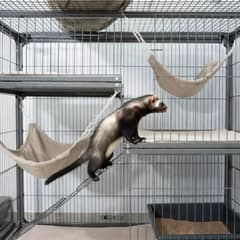
- Join the levels of the cage with tubes and fabric tunnels, so the ferret has routes to run instead of platforms to sit on.
- Lay tunnels across the play room floor and move them around every few days.
- Use what you have. A collapsible fabric tunnel is the cheap purpose-made option, and a row of cardboard boxes with holes cut in them works too.
A Place to Dig
Digging is one of the activities ferrets are reported to enjoy most. A ferret with no outlet finds its own: houseplants, the litter box, the carpet edge, the corner of the sofa.
A deep storage tub makes a dig box. Fill it with shredded paper or plain soil with no fertilizer, deep enough for the ferret to burrow under, and skip rice and dried beans, which a ferret should not eat. Set it on a sheet or in a bathtub, because the filling will fly, and stay nearby while the ferret digs.
Dark Places to Sleep
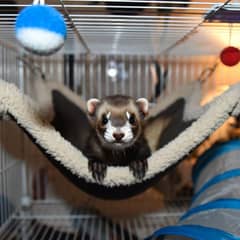
Hammocks are a ferret's favorite place to sleep, and polecats rest in enclosed dens. Offer both.
- Hang hammocks and sleep sacks on the upper levels of the cage.
- Add an enclosed hideout or a covered box, so there is somewhere fully dark.
- Give a pair enough beds that each ferret can sleep alone or piled together as it chooses.
Daily Time Out of the Cage
A ferret needs at least 2 to 4 hours outside its cage every day. No amount of cage furniture replaces that.
Ferrets sleep most of the day and are liveliest in the evening and early morning, and they shift their schedule toward yours. Plan play for when the ferret is awake and you are home. Make the room safe first: ferret-proof it by blocking gaps, covering cords and picking up the rubber and foam a ferret must not swallow.
Your attention is part of the enrichment. Play and contact with people rank among the things ferrets are most often given and most often seen to enjoy. Good games:
- Drag a toy or a rag on a string for the ferret to chase and pounce on.
- Hide in plain sight and let it find you, then let it chase you back.
- Roll a ball through a tunnel while the ferret is inside.
If play gets mouthy, keep your hand still and move the play onto a toy.
Hunting for Food
A polecat works for every meal. A pet ferret finds its food in a bowl. Close some of that gap:
- Scatter a little of the day's kibble through a snuffle mat or a box of crumpled paper.
- Hide a few pieces in a tunnel or under a cup.
- Keep the main bowl full as well. A ferret needs food available all day, so a food game adds to its meals and does not replace them.
Toys That Are Safe
Ferrets chew and swallow soft rubber, foam and latex, and a swallowed piece can block the gut. Choose toys that do not tear into chunks, and check them often. Throw a toy away as soon as it starts to come apart.
Company
Wild polecats live alone, but pet ferrets are social with people and often with each other. Welfare charities recommend a pair or small group, and groups are best kept to three or four. A single ferret can be content if you are its playmate every day. For one ferret, the daily play session is the whole of its social life, so it cannot be skipped.
How to Tell It Is Working
- Working: the ferret plays hard, does the hopping war dance, makes the soft chuckling sound called dooking, then sleeps deeply in a loose, relaxed pose.
- Not working: the ferret lies still with its eyes open for long stretches, screeches, or sleeps more than usual.
A bored ferret can look like a resting one. Ferrets kept without stimulation lie awake with their eyes open, which is easy to mistake for sleep, and they screech more. In a laboratory study, giving ferrets enrichment reduced those boredom signs, and the effect was still there 24 hours later.
A ferret that sleeps more than normal or loses interest in play may also be ill. A sudden change like that needs a vet within 24 hours, so do not wait to see whether more play fixes it.
Something New, One Change at a Time
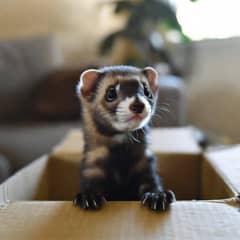
Exploring is on the list of things ferrets enjoy most, and novelty is the cheapest enrichment there is. Add or move one thing at a time, so you can see what the ferret does with it: a cardboard box, a paper bag with the handles cut off, a new tunnel layout, a towel to burrow under. Rotate toys in and out instead of leaving everything down at once.
Priority Order
- At least 2 to 4 hours out of the cage every day
- Play with you, a companion ferret, or both
- Tunnels and connected routes
- A dig box
- Hammocks, sleep sacks and a dark enclosed bed
- A multi-level cage with routes between levels
- Food to search for
- New objects, rotated
A Burrow Hunter in the Living Room
A ferret asks for the things its wild relative has: tunnels, somewhere to dig, a dark bed and a reason to move. Give it those and your time each day, and the sign that you have it right is a ferret that plays flat out and then sleeps hard.
Sources & Further Reading
Last reviewed 16 Nov 2026 · 6 sources
- Dancer AMM, Diez-Leon M, Bizley JK and Burn CC (2022), Animals: Housing and Environmental Enrichment of the Domestic Ferret: A Multi-Sector Survey; Pet Owner Perception of Ferret Boredom and Consequences for Housing, Husbandry, and Environmental Enrichment
- The Mammal Society: Polecat
- Wilson DE and Mittermeier RA (2009). Mustela putorius, in Handbook of the Mammals of the World, vol. 1
- Merck Veterinary Manual: Providing a Home for a Ferret; Management of Ferrets
- VCA Animal Hospitals: Gastrointestinal Diseases in Ferrets; Feeding Ferrets
- LafeberVet: Basic Information Sheet: Ferret
Frequently Asked Questions
What does a bored ferret look like?
Often like a resting one. A bored ferret lies awake with its eyes open, screeches more and may sleep more than usual, while a ferret that has played well sleeps deeply.
What enrichment do ferrets like most?
Keepers most often report tunnels, something to dig in, play with people and new things to explore. Hammocks are the item most ferrets already have.
Do ferrets dig tunnels?
Ferrets love to dig and to run through tunnels, though their wild relative the polecat mostly moves into burrows other animals made. A dig box and a set of tubes cover both urges.
How much out-of-cage time does a ferret need?
A minimum of 2 to 4 hours every day, with you in the room. Evening and early morning suit most ferrets best.
Should ferrets be kept alone?
One ferret can do well if you play with it every day. Many do better with a companion, and groups are usually kept to three or four.
Is a dig box worth it?
Yes. It costs almost nothing, and it gives the ferret somewhere to dig that is not your carpet or your houseplants.



Recommended Gear
As an Amazon Associate I earn from qualifying purchases through the links above, at no extra cost to you.

Written by Michael Ryan
Mike keeps two rescued bearded dragons, Dex and Cera, and writes the care guides on BeastlyFacts from his own research and mistakes. He is not a veterinarian.
More about Michael Ryan →You May Also Like


Subscribe - it's free
An occasional email when something new is worth your time. No spam.
Health and More