Sphynx
Felis catus
On This Page▾
🌍 Overview
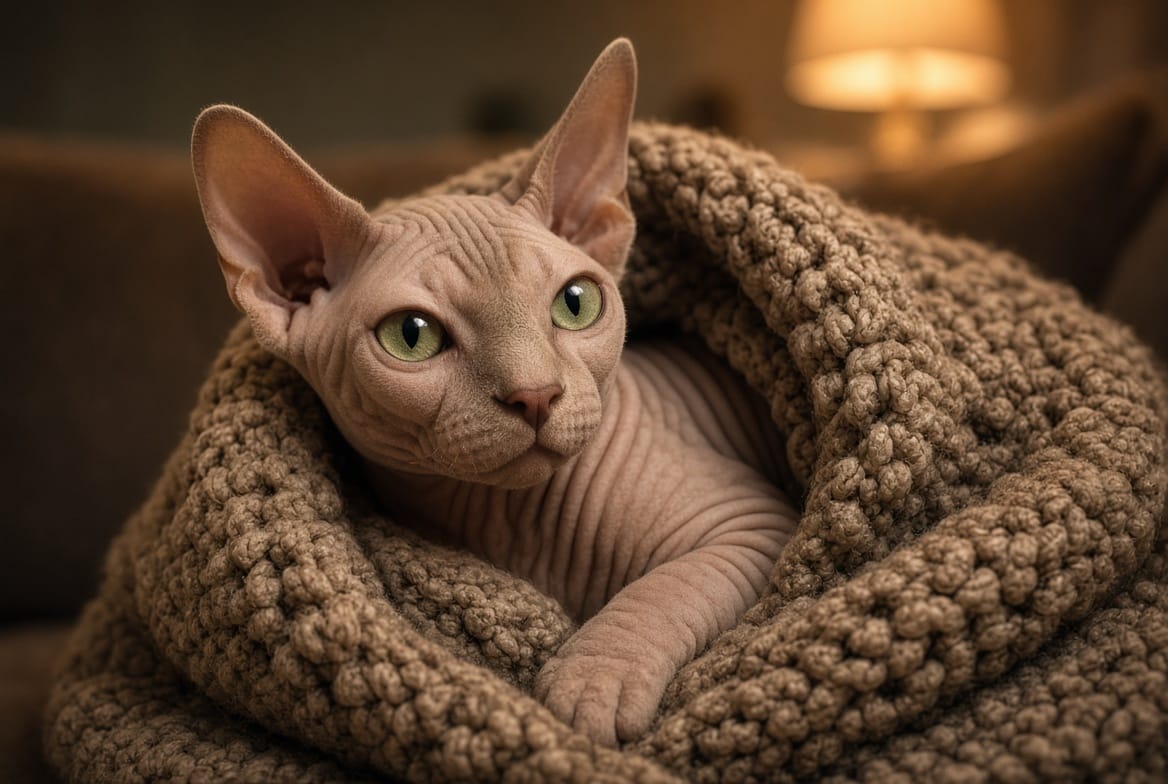
The Sphynx traces to a spontaneous mutation in 1966, when a domestic cat in Toronto gave birth to a hairless kitten. Breeders identified the trait as recessive and spent more than 30 years developing the breed by outcrossing to normal-coated cats, including Devon Rex and American Shorthair lines, and most modern Sphynx descend from two kittens found in Minnesota in 1975 and three found in Toronto in 1978. That repeated outcrossing left the breed genetically healthier than its rarity suggests, with observed heterozygosity of 0.58 against a purebred average of 0.51. The consequences of hairlessness are real and permanent: the oil glands work normally but there is no coat to absorb the secretions, so the skin stays greasy and needs routine bathing, and the cats sunburn easily, carry high rates of Malassezia yeast, and regulate body temperature poorly. The breed also carries a striking burden of hypertrophic cardiomyopathy, and in UK primary-care life tables the Sphynx had the shortest life expectancy of any breed reported, 6.8 years from birth against 11.7 years for cats overall. Since 1 January 2026 it has been prohibited to keep a hairless cat in the Netherlands, which in practice ends acquisition too, though trade and import were considered and deliberately left out of the decree as redundant. Breeding them had already been unlawful there since 2014. A cat that was already being kept before that date may be kept for the rest of its life, and may still change hands, provided the keeper can produce written proof of the date its microchip was placed or registered.
📋 Quick Facts
Native Range
Breed origin: Canada (a spontaneous hairless mutation in Toronto in 1966, developed over three decades with Devon Rex and American Shorthair outcrosses)
Natural Habitat
Fully domesticated
Adult Size
Medium and surprisingly heavy for its size, with a rounded belly, wrinkled skin and large bat-like ears; 6-14 lbs, about 8-10 inches tall. Not truly bald: short hair is usually present on the nose, ears and tail
Wild Diet
Fully domesticated
Wild Lifespan
8-14 years is the commonly quoted range, but UK primary-care life tables give the Sphynx the shortest life expectancy of any breed reported at 6.8 years from birth, against 11.7 for cats overall
Conservation Status
Not applicable (domesticated breed)
📜 History
Hairless cats had appeared and vanished before. E. J. Shinick of Albuquerque acquired a hairless brother and sister, Dick and Nellie, from Pueblo neighbors around 1894 and described them in a letter printed in Frances Simpson's The Book of the Cat in 1903, where they were advertised as the last of an Aztec breed. Dick was killed by dogs within a year or two, Nellie was sent east and died soon after reaching the Smithsonian Institution, where she was mounted as a specimen, and the line ended with her. Nothing was salvaged from that mutation, so the modern breed rests entirely on the Canadian line. The CFA accepted the Sphynx for registration in 1998 and granted championship status in 2002.
⚖️ Compare
Sphynx
Human
Adult Size
Medium and surprisingly heavy for its size, with a rounded belly, wrinkled skin and large bat-like ears; 6-14 lbs, about 8-10 inches tall. Not truly bald: short hair is usually present on the nose, ears and tail
5-6 feet (150-185 cm); ~135-200 lbs
Wild Lifespan
8-14 years is the commonly quoted range, but UK primary-care life tables give the Sphynx the shortest life expectancy of any breed reported at 6.8 years from birth, against 11.7 for cats overall
~73 years (global average)
Wild Diet
Fully domesticated
Omnivorous - eats just about anything
Native Range
Breed origin: Canada (a spontaneous hairless mutation in Toronto in 1966, developed over three decades with Devon Rex and American Shorthair outcrosses)
Global - originated in Africa roughly 300,000 years ago
Natural Habitat
Fully domesticated
Everywhere from arctic tundra to tropical megacities
Conservation Status
Not applicable (domesticated breed)
Least Concern (8+ billion and counting)
🧠 Test Yourself
What's the Sphynx's native range?
🤩 Fun Facts
😺 Feline Mustache
Sphynx cats are naturally hairless due to a genetic mutation, but their exposed skin is just as sensitive as ours! These quirky kitties are known for their affectionate nature and unique 'mustache' whiskers that contribute to their charming personality.
😺 Always Running Warm
With no fur coat for insulation, Sphynx cats run a noticeably higher body temperature and faster metabolism than other cats, which is why they seek out warm laps and sunny windowsills and often need sweaters in winter. They also need regular baths since their skin oils have nowhere else to go.
⚖️ Legal Guide
Subscribe - it's free
New animal facts and care guides straight to your inbox. No spam. 🐾
🩺 Health and More
🐈 Cat Enrichment: Five Pillars, and Most Homes Miss the Second One
🧬 What a Pet DNA Test Actually Tells You
👁️ Inherited Eye Disease: What Screening Actually Catches
🫀 Cardiomyopathy in Cats and Dogs: HCM, DCM and What They Mean
🦷 Dental Disease: Why White Teeth Do Not Mean a Healthy Mouth
🐱 Why Cats Need Mental Enrichment (And How Boredom Can Break Them)
🤓 Did You Know?
Despite being one of the rarest-looking pedigree cats, the Sphynx is genetically better off than many mainstream breeds. Repeated outcrossing to Devon Rex and American Shorthair lines over more than 30 years left it with observed heterozygosity of 0.58, above the purebred average of 0.51 and above the Persian's.
Explore More