Fire-Bellied Toad
Bombina orientalis
On This Page▾
🌍 Overview
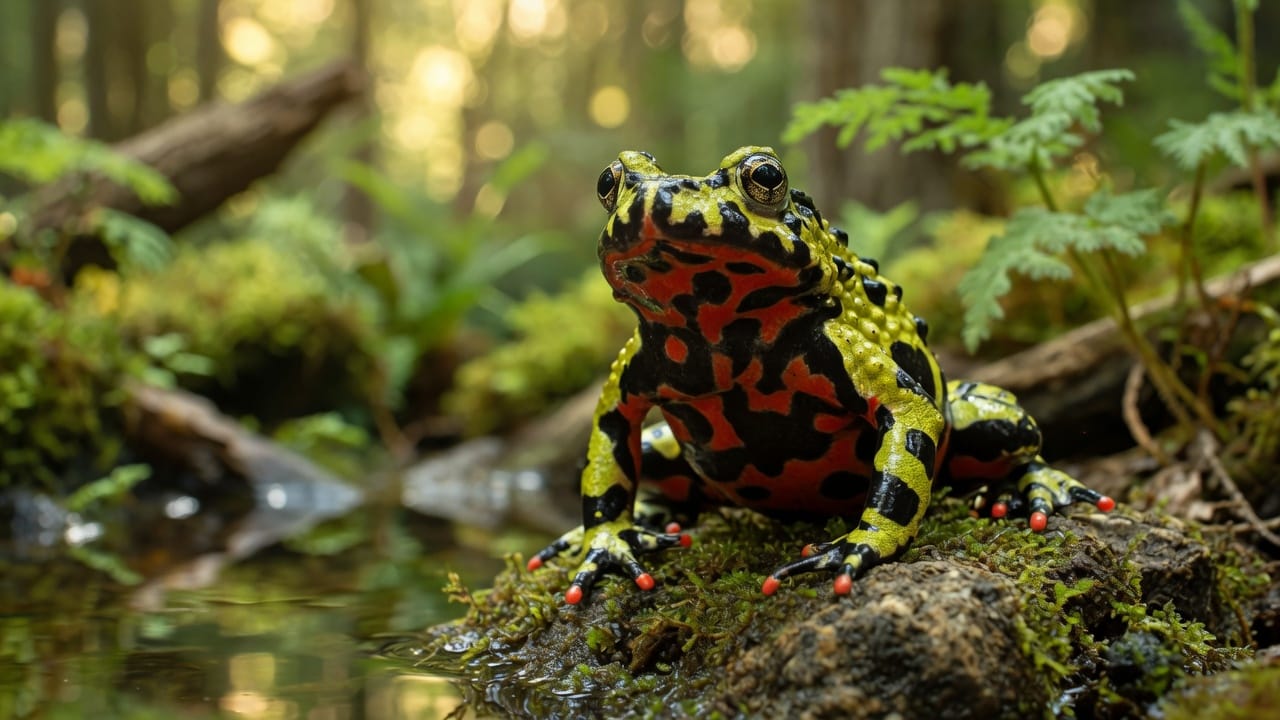
The Oriental fire-bellied toad is native to northeastern China, Korea, and the Russian Far East, where it inhabits slow-moving streams and mountain ponds. Its vivid red and orange belly serves as aposematic warning coloration - signaling to predators that it is toxic. When threatened, it arches its back to display this warning coloration (the unken reflex). Fire-bellied toads produce skin secretions toxic enough to irritate mucous membranes and eyes.
📋 Quick Facts
Native Range
Northeastern China, Korea, and Russian Far East
Natural Habitat
Mountain streams, ponds, marshes, and wet meadows
Adult Size
1.5-2 inches (4-5 cm)
Wild Diet
Insects, worms, small crustaceans, and aquatic invertebrates
Wild Lifespan
Maximum longevity in the wild is estimated at 20 years; up to 30 years in captivity
Conservation Status
Least Concern (IUCN)
📜 History
George Albert Boulenger described the species in 1890 as Bombinator orientalis, working from specimens held at the British Museum. It went on to become the most commonly kept member of its genus, exported from Korea and China in large numbers. That volume turned out to matter: a study published in Science in May 2018 and led by Imperial College London traced the amphibian-killing chytrid fungus Batrachochytrium dendrobatidis to East Asia, found its most genetically diverse lineage confined to the Korean peninsula, and dated the pathogen's global expansion to the past 50 to 120 years. Asian strains of that fungus were recovered from pet oriental fire-bellied toads, direct evidence that the trade carried it. The IUCN assessed the species as Least Concern in 2020.
⚖️ Compare
Fire-Bellied Toad
Human
Adult Size
1.5-2 inches (4-5 cm)
5-6 feet (150-185 cm); ~135-200 lbs
Wild Lifespan
Maximum longevity in the wild is estimated at 20 years; up to 30 years in captivity
~73 years (global average)
Wild Diet
Insects, worms, small crustaceans, and aquatic invertebrates
Omnivorous - eats just about anything
Native Range
Northeastern China, Korea, and Russian Far East
Global - originated in Africa roughly 300,000 years ago
Natural Habitat
Mountain streams, ponds, marshes, and wet meadows
Everywhere from arctic tundra to tropical megacities
Conservation Status
Least Concern (IUCN)
Least Concern (8+ billion and counting)
🧠 Test Yourself
What's the Fire-Bellied Toad's native range?
📖 Care Guide
Fire-Bellied Toad Care Guide
The little green toad that flips over to flash a fiery belly!
Subscribe - it's free
New animal facts and care guides straight to your inbox. No spam. 🐾
📰 Deep Dive
🐸 How Much Does a Fire-Bellied Toad Really Cost?
🐸 Fire-Bellied Toads Have Genuinely Toxic Skin, Here's What That Means
🐸 Common Fire-Bellied Toad Health Issues (Water Quality Is Everything)
🐸 Fire-Bellied Toad Enclosure Setup: Half Fish Tank, Half Terrarium
🐸 Fire-Bellied Toad Feeding: Live Prey It Has to Leap For, Two to Six Items Every Few Days, and Nothing Hard-Shelled
🐸 Fire-Bellied Toad Enrichment: Plants Beat Pipes, and Someone Tested It
🩺 Health and More
🤓 Did You Know?
The bright red-orange belly is a warning display, not decoration. Threatened, the toad arches its back and lifts its limbs to show the color off, and every stage after that arch is the animal spending toxin on whatever is holding it.
Explore More