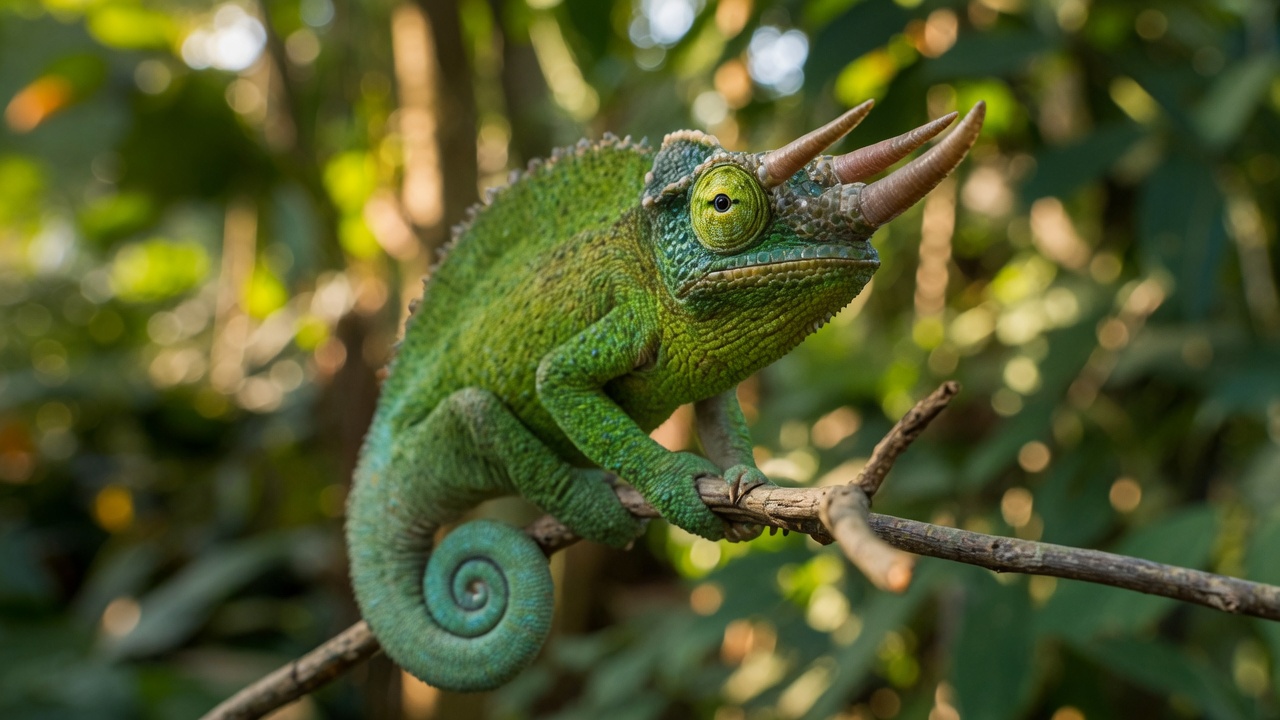
Jackson's Chameleon
Lizards
The horned, color-shifting dinosaur of the reptile world!
🤓 Did you know? Jackson's chameleons are one of the few chameleon species that give live birth rather than laying eggs. Females can birth 8 to 30 live young!
🏠 Housing & Setup
A 24x24x48" all-screen enclosure is the minimum for a single adult Jackson's chameleon. Screen construction is non-negotiable - stagnant air in glass or plastic enclosures causes rapid onset respiratory infections in chameleons. Airflow must be constant and significant. Many experienced keepers use screen cages outdoors in appropriate climates, which is close to ideal.
Live plants are essential, not decorative. Pothos, ficus, hibiscus, and dracaena provide natural humidity regulation, visual barriers for security, resting surfaces, and environmental complexity. Bare enclosures produce chronically stressed, sick chameleons. Aim for at least 60 to 70% plant coverage of the enclosure interior.
Temperature requirements: daytime ambient of 72 to 80 degrees F with a basking spot of 85 to 88 degrees F. Jackson's chameleons prefer cooler temperatures than most other chameleon species - they originate from the cool highlands of East Africa and Hawaii's Maui island. Nighttime temperatures can drop to 55 to 65 degrees F, which is actually beneficial. Never allow temperatures to exceed 90 degrees F. Strong UVB (T5 HO Arcadia 6% or 12%) is mandatory.
A dripper system and/or automatic misting system is required for hydration. Chameleons almost never drink from standing water - they drink water droplets from leaves and their environment after rainfall. A dripper creating slow drips onto leaves for 30 to 60 minutes morning and afternoon, combined with a fine misting system that runs for 3 to 5 minutes several times daily, meets hydration and humidity needs.
🥗 Diet & Feeding
Jackson's chameleons eat live insects exclusively. The variety of feeder insects is one of the most important factors in long-term health. Offer crickets, dubia roaches, hornworms, silkworms, black soldier fly larvae, and blue bottle flies. Each insect species has a different nutritional profile, and rotation provides comprehensive nutrition. Avoid relying on a single feeder type.
Gut-loading feeder insects 24 to 48 hours before feeding is critical. Feed insects a high-quality commercial gut-load or fresh vegetables (collard greens, mustard greens, sweet potato, carrot, apple). The chameleon's nutrition is entirely dependent on what its prey ate. An unloaded cricket offers minimal nutritional value.
Feed juveniles daily (as many as they will eat in 15 minutes). Feed adults every other day, offering 5 to 10 appropriately sized insects. Prey should be no larger than the width of the chameleon's head. Overfeeding causes obesity, which stresses the liver and reproductive system.
Supplementation schedule: calcium without D3 at every or every-other feeding, calcium with D3 twice weekly, and a reptile multivitamin once per week. Jackson's chameleons are sensitive to over-supplementation as much as under-supplementation. Follow this schedule precisely.
🎮 Enrichment & Handling
Dense, multi-level branching is the most important structural enrichment. Chameleons are almost entirely arboreal and spend their lives navigating through a three-dimensional network of branches and leaves. Horizontal branches at multiple heights, thin perching vines at the top (where they feel safest), and thick branches lower for basking create the complexity they need.
The dripper and misting system doubles as enrichment - chameleons investigate and drink droplets naturally and actively. Watching a chameleon track and hunt live prey is a major appeal of keeping them; the prey variety itself provides mental engagement.
Handle minimally. Chameleons are not handling animals. Stress is a primary health concern - a chronically stressed chameleon will stop eating, develop immune suppression, and die. Many chameleons spend their entire lives in their enclosure without needing to be handled. When handling is necessary (for veterinary visits, enclosure cleaning), move slowly, allow the chameleon to walk onto your hand voluntarily, and keep sessions as brief as possible.
Jackson's chameleons are live-bearing (viviparous), unlike most chameleon species that lay eggs. A gravid female needs adequate nutrition and a suitable warm, humid hiding area. Breeding is not recommended without extensive experience.
💊 Health & Common Issues
Chameleons are masters of concealing illness. By the time a chameleon shows obvious signs of sickness - color changes, sunken eyes, closed eyes during the day, gaping mouth, lethargy - it has usually been ill for some time and is severely compromised. Attentive daily observation of baseline behavior is essential. Know what your chameleon's normal colors, activity level, and feeding response look like.
Dehydration is the single most common cause of early death in pet chameleons. Sunken eyes (the most visible sign), dark coloration, and lethargy indicate dehydration. A chameleon that is not drinking needs immediate intervention: long misting sessions, paper towel soaks, and veterinary care if the animal does not rehydrate quickly. Maintain the dripper and misting schedule without gaps.
Metabolic Bone Disease (MBD) from inadequate UVB or supplementation causes swollen limbs, deformities, and difficulty moving. Maintain proper UVB schedules, replace UVB bulbs on schedule, and follow supplementation protocols exactly.
Respiratory infections result from stagnant air and temperature fluctuations. The all-screen enclosure mandate is specifically to prevent this. Female Jackson's chameleons can develop reproductive problems (dystocia, retained offspring) that require veterinary intervention. Find a reptile vet with chameleon experience before you need one - do not wait for an emergency to identify your veterinary resource.
✅ Complete Care Checklist
Cost Builder
Uncheck anything you already have to see your real total.
One-Time Setup
Ongoing (Per Year)
Setup total
$345-$655
Per year after
$365-$655
Rough estimates to help you plan - actual prices vary by region and retailer. Underlined items are paid Amazon links - we may earn a commission at no extra cost to you.
❓ Frequently Asked Questions
Are chameleons hard to keep?
Chameleons are widely considered one of the most demanding reptiles in the hobby and are not recommended for first-time reptile keepers. They require very specific conditions: all-screen enclosures for ventilation, precise temperature gradients, high humidity with a wet-dry cycle, strong UVB lighting, live gut-loaded insects at every feeding, and a dripper or automatic misting system for hydration. They are also highly stress-sensitive - improper conditions or a high-traffic cage location cause rapid health decline. Experienced keepers find them deeply rewarding; beginners often experience significant losses.
Why do chameleons change color?
Chameleons change color primarily to communicate mood, social status, and reproductive readiness - not primarily for camouflage as commonly believed. Bright, vivid colors often signal excitement, territorial aggression, or a male displaying to a female. Dark, muted colors typically indicate stress, illness, or cold. The color change is achieved by manipulating nanocrystals within specialized skin cells called iridophores, which reflect different wavelengths of light depending on their arrangement.
How do I get my chameleon to drink water?
Chameleons rarely drink from standing water bowls - in the wild, they drink droplets from leaves after rain. Provide water by misting the enclosure 2 to 3 times daily so the chameleon can drink from leaves and cage walls. A dripper system that slowly keeps leaves wet is highly effective. Always use dechlorinated or filtered water. Signs of dehydration include sunken eyes, lethargy, and yellow-orange urates - the urate portion of droppings should be white, not yellow.
How big do veiled chameleons get?
Male veiled chameleons typically reach 18 to 24 inches total length and 140 to 200 grams - they are among the larger chameleon species kept in captivity. Females are noticeably smaller at 10 to 13 inches, but require more advanced care because they are prone to reproductive issues. Females produce infertile eggs even without a male and must have a deep laying box available at all times to prevent fatal egg-binding.
How long do chameleons live?
Captive-bred veiled chameleons live 5 to 8 years with optimal care, with males often outliving females (females that lay frequent clutches have significantly shortened lifespans). Jackson's chameleons live 5 to 10 years. Panther chameleons live 3 to 7 years. Wild-caught chameleons rarely survive long in captivity due to extreme capture stress. Regular access to a vet experienced with chameleons dramatically improves outcomes at any age.
Subscribe - it's free
New care guides straight to your inbox. No spam. 🐾
🤩 Fun Facts
🦎 Color Means Communication
Chameleons don't change color primarily for camouflage. They do it to communicate mood and temperature. Color changes signal stress, excitement, readiness to mate, and more.
🦎 Color-Changing Camouflage
Chameleons are famous for their ability to change color, but did you know it's primarily a way to communicate? They alter their hues depending on their mood and social signals, rather than just blending into their surroundings!
🦎 Chameleon Color Change
Chameleons are famous for their color-changing abilities, but it's not just for camouflage! They change colors in response to mood, temperature, and even social signals, making them masters of both disguise and emotion!