Tiger Salamander
Ambystoma tigrinum
On This Page▾
🌍 Overview
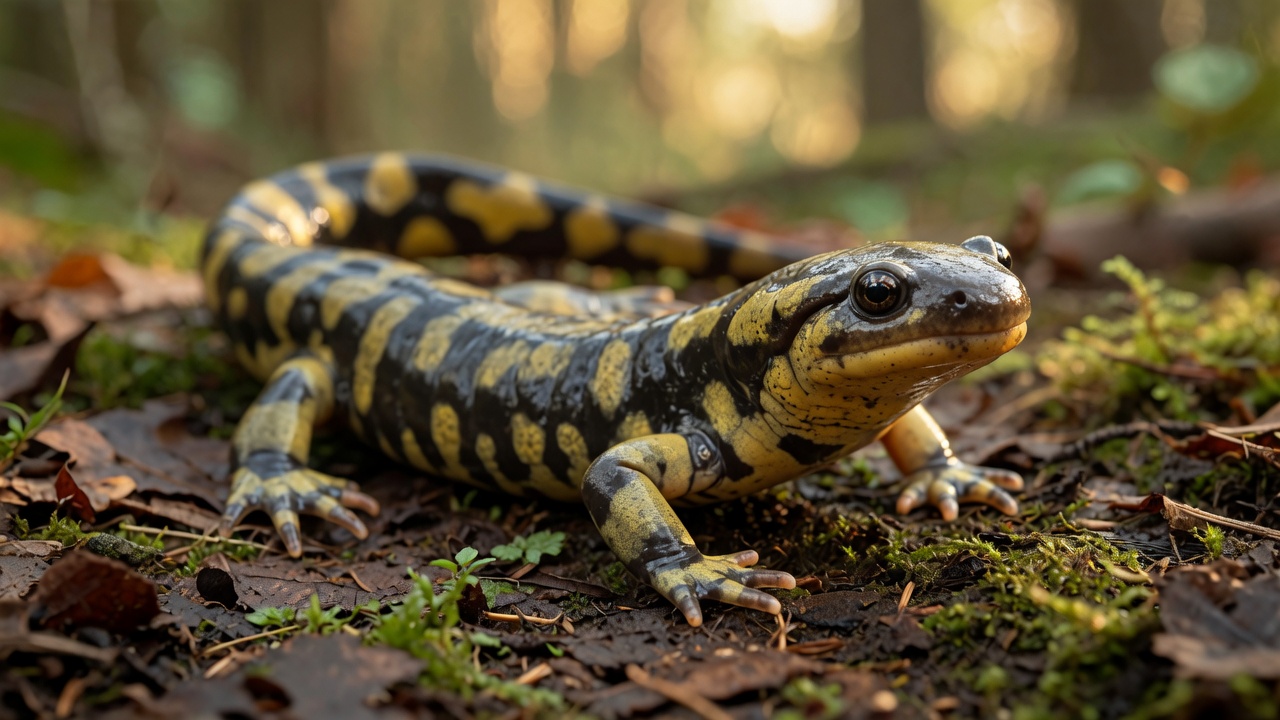
The tiger salamander is the largest land-dwelling salamander in North America, found across a vast range from Canada to Mexico. They are burrowing animals that spend most of their lives underground, emerging to breed in temporary and permanent ponds. In some lake environments, individuals remain permanently aquatic and sexually mature without fully metamorphosing - a neotenic phenomenon. Some of these neotenic populations were historically described as entirely separate species before genetic analysis revealed their true relationship.
📋 Quick Facts
Native Range
North America (Canada to Mexico; widespread across the continent)
Natural Habitat
Grassland, forest, and marshland; adjacent to breeding ponds
Adult Size
8-13 inches (20-33 cm)
Wild Diet
Worms, insects, slugs, frogs, small mice, and other salamanders
Wild Lifespan
10+ years in the wild (documented as 10 years or more, with no established upper bound; the often-quoted teens figure is a captive range)
Conservation Status
Least Concern (IUCN)
📜 History
Jacob Green described the species in 1825, but its most consequential history has been commercial. Larvae are sold across the United States as fishing bait under the name waterdogs, and West Coast populations exist because bait animals were released there rather than because the species spread on its own. In California that trade produced a genetic emergency: barred tiger salamanders introduced into central California ponds in the middle of the twentieth century interbred with the federally endangered California tiger salamander, and work by Benjamin Fitzpatrick and Bradley Shaffer published in the Proceedings of the National Academy of Sciences in September 2007 found the hybrids unexpectedly vigorous. The same trade moves Ambystoma tigrinum virus, a ranavirus common in bait shop stock.
⚖️ Compare
Tiger Salamander
Human
Adult Size
8-13 inches (20-33 cm)
5-6 feet (150-185 cm); ~135-200 lbs
Wild Lifespan
10+ years in the wild (documented as 10 years or more, with no established upper bound; the often-quoted teens figure is a captive range)
~73 years (global average)
Wild Diet
Worms, insects, slugs, frogs, small mice, and other salamanders
Omnivorous - eats just about anything
Native Range
North America (Canada to Mexico; widespread across the continent)
Global - originated in Africa roughly 300,000 years ago
Natural Habitat
Grassland, forest, and marshland; adjacent to breeding ponds
Everywhere from arctic tundra to tropical megacities
Conservation Status
Least Concern (IUCN)
Least Concern (8+ billion and counting)
🧠 Test Yourself
What's the Tiger Salamander's native range?
🤩 Fun Facts
🐅 A Species That Fits in a Town
Around 5,500 tigers remain in the wild, across thirteen countries, for the entire species. A century ago the estimate was near 100,000. They have lost roughly 93 to 95 percent of their historic range, and three subspecies are already gone: the Bali, Caspian and Javan tigers.
🐅 Striped to the Skin
Tiger stripes are not only in the fur. The pattern is in the skin underneath, so a shaved tiger is still striped. Every tiger's arrangement is unique, which is genuinely useful: camera trap surveys identify individual animals by stripe pattern the way you would use a fingerprint, and much of what we know about remaining numbers comes from exactly that.
📖 Care Guide
Tiger Salamander Care Guide
The stout, blotchy burrower that begs for food like a puppy!
⚖️ Where it is legal
33 US jurisdictions restrict this species, from outright bans to permits. Every one quotes the rule it comes from.
⚖️ Legal Guide
Subscribe - it's free
New animal facts and care guides straight to your inbox. No spam. 🐾
📰 Deep Dive
🦎 How Much Does a Tiger Salamander Really Cost?
🦎 How to Handle a Tiger Salamander (And Why You Mostly Won't See One)
🦎 Common Tiger Salamander Health Issues
🦎 Tiger Salamander Enclosure Setup: Deep Substrate for a Species That Lives Underground
🦎 Tiger Salamander Feeding: Worms and Crickets at Night, Twice a Week, and an Animal That Never Says No
🦎 Tiger Salamander Enrichment: Underground Is Where the Animal Lives
🩺 Health and More
🧼 Salmonella and Reptile Hygiene: The Rules That Actually Matter
🛁 Tubbing, Cooling, and Salt Baths for Sick Axolotls
🧊 Cooling an Aquarium Without a Chiller
🧪 Amphibian Quarantine, Acclimation, and Water Hardness: The Full Guide
⚖️ Four Pets Whose Size Tells You the Wrong Thing
🦎 Tiger Salamander vs. Axolotl: Which Salamander Actually Fits Your Setup
🤓 Did You Know?
Tiger salamanders are one of North America's largest terrestrial salamanders, reaching 13 inches. They are also among the most cold-tolerant amphibians on the continent, naturally overwintering underground in frozen soil across much of the US and Canada.
Explore More