Scottish Fold
Felis catus
On This Page▾
🌍 Overview
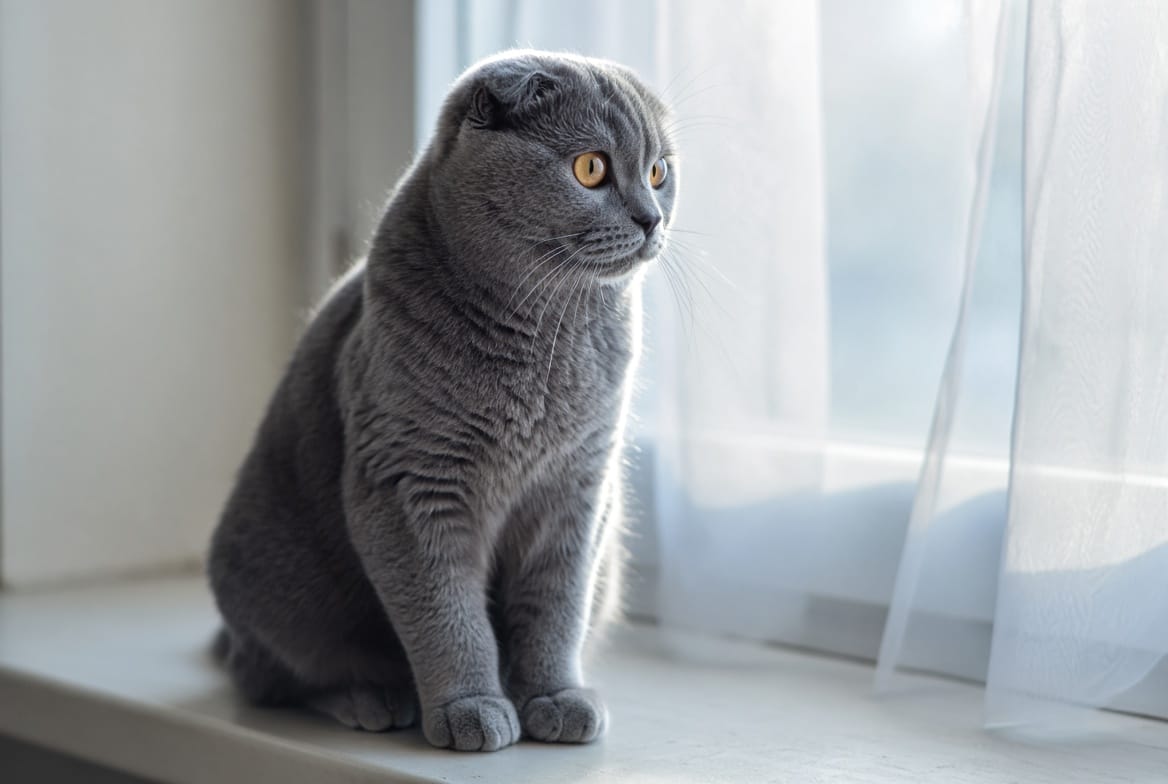
The Scottish Fold began in 1961 when a shepherd found a folded-ear cat named Susie on a farm in the Tayside region of Scotland. Susie produced only one litter, so her daughter Snooks became the foundation queen, and the breed was built out through crosses with British Shorthairs and domestic cats. The fold comes from a dominant variant in TRPV4, a gene encoding an ion channel whose correct activation is crucial for normal development of cartilage and bone cells, and that is the central problem with the breed: the mutation does not act only on ear cartilage. It affects cartilage throughout the body, producing a progressive degenerative osteochondrodysplasia, and while early work suggested only cats with two copies were affected, recent evidence indicates any cat carrying at least one copy of the ear-folding variant can develop it. FIFe deleted the breed's registration codes with effect from 1 January 2012 and its rules state they cannot be re-created, which makes this one of the very few cases of a registry de-recognizing a breed outright on health grounds. The British Veterinary Association states that there is no excuse not to condemn breeding of the Scottish Fold, because the same disorder that folds the ears means these cats develop painful arthritis for much, if not all, of their lives. The CFA recognizes the breed, granting championship status to shorthairs in 1978, longhairs in 1992 and straight-eared cats in 2022, but FIFe will not register cats with osteochondrodysplasia or any cat with such a cat in its ancestry, the UK's Governing Council of the Cat Fancy does not recognize the breed on welfare grounds, and since 1 January 2026 it has been prohibited to keep a folded-ear cat in the Netherlands, with the decree naming the TRPV4 variant directly and presuming any cat with forward-drooping ears to carry it.
📋 Quick Facts
Native Range
Breed origin: Scotland (a single folded-ear farm cat, Susie, found in the Tayside region in 1961; her daughter Snooks became the breed's foundation queen)
Natural Habitat
Fully domesticated
Adult Size
Medium, stocky and round; 6-13 lbs, about 8-10 inches tall. A thickened, inflexible tail and a stiff gait are clinical signs of osteochondrodysplasia, not breed type
Wild Diet
Fully domesticated
Wild Lifespan
14-16 years is the commonly quoted average (UK primary-care life tables put life expectancy at birth for all cats at 11.7 years)
Conservation Status
Not applicable (domesticated breed)
📜 History
The registry that now refuses the breed once accepted it. William Ross registered his folded-ear cats with the Governing Council of the Cat Fancy in 1966, and the GCCF stopped registering them in 1971 over concerns about limb deformity, ear infection and deafness. Three kittens had already been shipped in 1970 to Neil Todd, a New England researcher studying spontaneous mutations in cats, and American breeders picked up the line from there. The CFA granted provisional status in 1977, and the breed's development has run through North American catteries ever since.
⚖️ Compare
Scottish Fold
Human
Adult Size
Medium, stocky and round; 6-13 lbs, about 8-10 inches tall. A thickened, inflexible tail and a stiff gait are clinical signs of osteochondrodysplasia, not breed type
5-6 feet (150-185 cm); ~135-200 lbs
Wild Lifespan
14-16 years is the commonly quoted average (UK primary-care life tables put life expectancy at birth for all cats at 11.7 years)
~73 years (global average)
Wild Diet
Fully domesticated
Omnivorous - eats just about anything
Native Range
Breed origin: Scotland (a single folded-ear farm cat, Susie, found in the Tayside region in 1961; her daughter Snooks became the breed's foundation queen)
Global - originated in Africa roughly 300,000 years ago
Natural Habitat
Fully domesticated
Everywhere from arctic tundra to tropical megacities
Conservation Status
Not applicable (domesticated breed)
Least Concern (8+ billion and counting)
🧠 Test Yourself
What's the Scottish Fold's native range?
⚖️ Legal Guide
Subscribe - it's free
New animal facts and care guides straight to your inbox. No spam. 🐾
🩺 Health and More
🐈 Cat Enrichment: Five Pillars, and Most Homes Miss the Second One
🧬 What a Pet DNA Test Actually Tells You
👁️ Inherited Eye Disease: What Screening Actually Catches
🫘 Kidney Disease in Cats: What the Numbers Actually Mean
🫀 Cardiomyopathy in Cats and Dogs: HCM, DCM and What They Mean
⚖️ Body Condition Score: How to Tell if Your Pet Is Actually Overweight
🤓 Did You Know?
Every Scottish Fold in the world traces back to one barn cat, Susie, found in Tayside, Scotland in 1961, and because she produced only a single litter it was her daughter Snooks who became the breed's foundation queen. The uncomfortable corollary is that the fold and the cartilage disease are the same dominant mutation, so no amount of selective breeding can keep one and discard the other.
Explore More