Dachshund
Canis lupus familiaris
On This Page▾
🌍 Overview
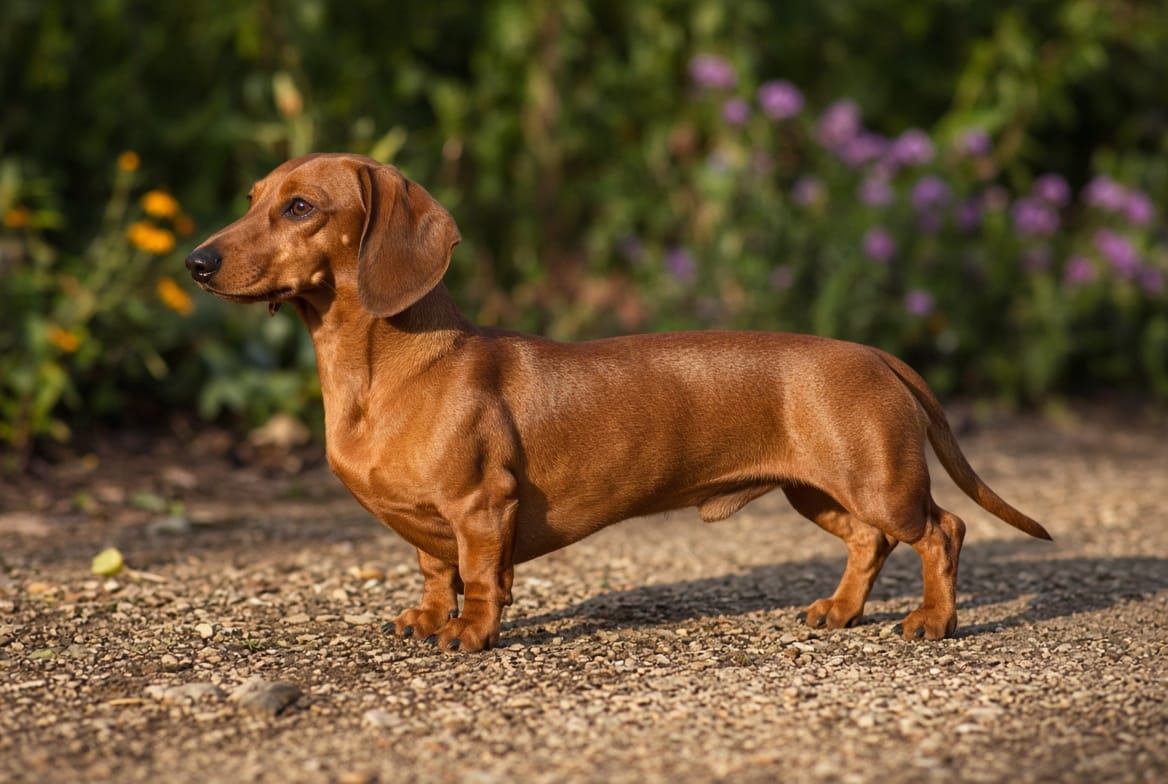
Dachshund is German for badger dog, and the breed was built to do exactly that, going to ground after burrowing carnivores. German foresters bred the type consistently through the 18th century, with the smooth coat considered original, longhairs following from selective breeding, and wirehairs arriving in the 1800s through crosses with rough-coated terriers. A boom in Germany's rabbit population produced the miniature, a smaller version for smaller quarry. The short legs that let the dog fit down a badger sett are not a cosmetic trait: they come from an FGF4 retrogene on chromosome 12 that simultaneously causes premature degeneration and calcification of the intervertebral discs, carrying an odds ratio of 51.23 for disc disease. The retrogene sits at a frequency of about 0.99 in the breed, meaning the defining silhouette and the defining disease are effectively the same mutation.
📋 Quick Facts
Native Range
Breed origin: Germany (bred by foresters from the late 17th century to go to ground after badgers, with a miniature developed in the 1800s for rabbit)
Natural Habitat
Fully domesticated
Adult Size
Standard 8-9 inches at shoulder, 16-32 lbs; Miniature 5-6 inches, 11 lbs and under
Wild Diet
Fully domesticated
Wild Lifespan
12-16 years
Conservation Status
Not applicable (domesticated breed)
📜 History
Formal standardization arrived only in the late 1800s. The Deutscher Teckelklub was founded in 1888, fixed the breed's type, and still sets the international standard used today. German affection for the dog later put it at the center of an Olympic first: Waldi, mascot of the 1972 Munich Games, was the first official Olympic mascot ever produced. Otl Aicher designed him in pastel stripes and modeled him on a real dachshund named Cherie von Birkenhof, the breed picked for its Bavarian popularity and for qualities the organizers called indispensable to an athlete, namely resistance, tenacity and agility.
⚖️ Compare
Dachshund
Human
Adult Size
Standard 8-9 inches at shoulder, 16-32 lbs; Miniature 5-6 inches, 11 lbs and under
5-6 feet (150-185 cm); ~135-200 lbs
Wild Lifespan
12-16 years
~73 years (global average)
Wild Diet
Fully domesticated
Omnivorous - eats just about anything
Native Range
Breed origin: Germany (bred by foresters from the late 17th century to go to ground after badgers, with a miniature developed in the 1800s for rabbit)
Global - originated in Africa roughly 300,000 years ago
Natural Habitat
Fully domesticated
Everywhere from arctic tundra to tropical megacities
Conservation Status
Not applicable (domesticated breed)
Least Concern (8+ billion and counting)
🧠 Test Yourself
What's the Dachshund's native range?
🤩 Fun Facts
🐕 Built for the Burrow
Dachshunds were bred in 18th century Germany specifically to hunt badgers, and their name literally means badger dog in German. Their short legs and long spine come from chondrodysplasia, a form of dwarfism that keeps the leg bones short while the rest of the body grows normally, ideal for squeezing through narrow burrows. That same long spine is why the breed is prone to disc problems later in life.
⚖️ Legal Guide
Subscribe - it's free
New animal facts and care guides straight to your inbox. No spam. 🐾
🩺 Health and More
🐕 Dog Enrichment: Let Them Sniff, and the Dog Gets More Optimistic
🐕 Dachshund Enrichment: Keep It at Floor Level
🧬 What a Pet DNA Test Actually Tells You
👁️ Inherited Eye Disease: What Screening Actually Catches
🦴 IVDD: Why Short Legs and Bad Backs Come From the Same Gene
🦷 Dental Disease: Why White Teeth Do Not Mean a Healthy Mouth
🤓 Did You Know?
The Dachshund's short legs are not selective breeding for cuteness. They come from an FGF4 retrogene, a copied gene that reinserted itself on chromosome 12, and it sits at a frequency of about 0.99 in the breed. The same insertion that produces the shape also drives premature disc degeneration, with an odds ratio of 51.23 for intervertebral disc disease.
Explore More