Bengal
Felis catus
On This Page▾
🌍 Overview
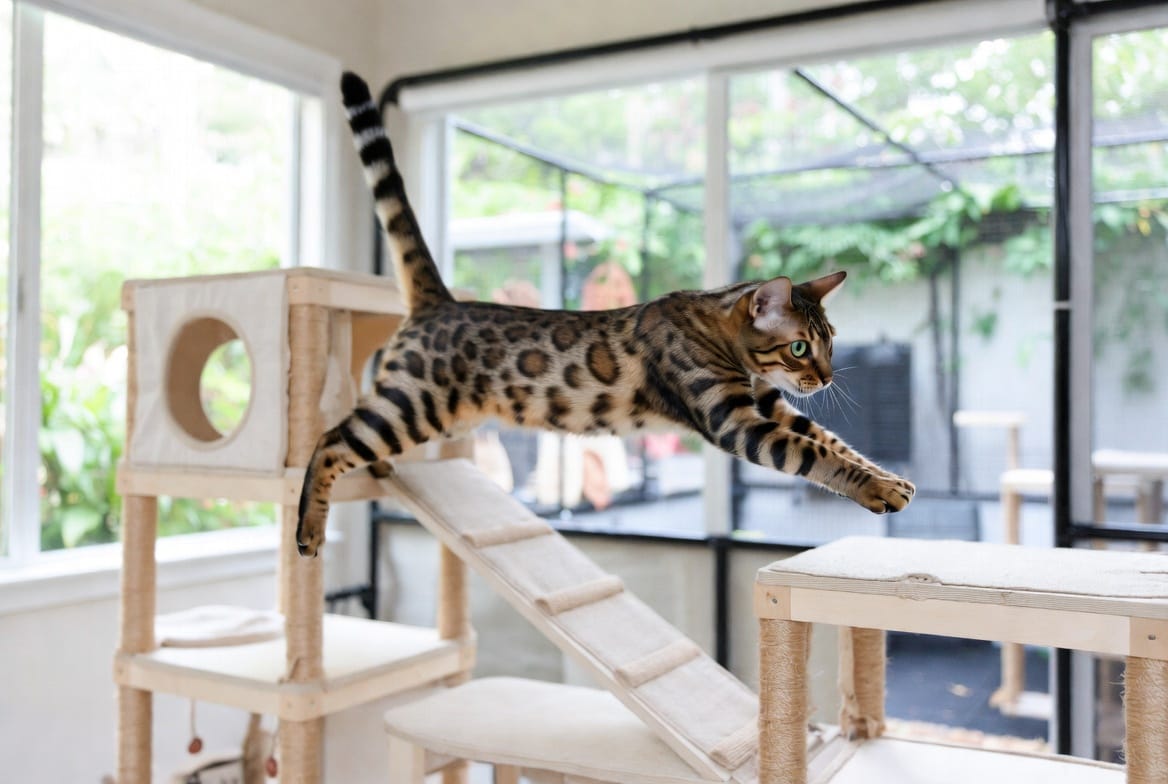
The Bengal cat is a hybrid breed produced by crossing domestic cats with the Asian leopard cat (Prionailurus bengalensis), a small wild felid native to South and East Asia. The result is a striking, athletic cat with a wild spotted coat and a highly active temperament. Early-generation hybrids can be difficult to manage; F4 and later generations are fully domestic but retain their wild appearance and high energy, requiring extensive enrichment to prevent problem behaviors.
📋 Quick Facts
Native Range
Breed origin: United States; hybrid with Asian leopard cat
Natural Habitat
Fully domesticated
Adult Size
13-16 inches at shoulder; 8-15 lbs
Wild Diet
Fully domesticated
Wild Lifespan
12-16 years
Conservation Status
Not applicable (domesticated breed)
📜 History
The breed came out of a laboratory as much as a cattery. Jean Mill made the first documented cross between a domestic cat and an Asian leopard cat in 1963 in Yuma, Arizona. In 1975 the physician Willard Centerwall gave her a group of hybrids left over from his Loma Linda research into whether the leopard cat's resistance to feline leukemia virus could pass to its offspring, and those cats became the breeding base. Mill later added a spotted street tom collected from the rhinoceros enclosure at the New Delhi zoo in 1982, registered as Millwood Tory of Delhi. TICA accepted the Bengal as a new breed in 1986 and granted it championship status in 1991.
⚖️ Compare
Bengal
Human
Adult Size
13-16 inches at shoulder; 8-15 lbs
5-6 feet (150-185 cm); ~135-200 lbs
Wild Lifespan
12-16 years
~73 years (global average)
Wild Diet
Fully domesticated
Omnivorous - eats just about anything
Native Range
Breed origin: United States; hybrid with Asian leopard cat
Global - originated in Africa roughly 300,000 years ago
Natural Habitat
Fully domesticated
Everywhere from arctic tundra to tropical megacities
Conservation Status
Not applicable (domesticated breed)
Least Concern (8+ billion and counting)
🧠 Test Yourself
What's the Bengal's native range?
⚖️ Where it is legal
20 US jurisdictions restrict this species, from outright bans to permits. Every one quotes the rule it comes from.
Subscribe - it's free
New animal facts and care guides straight to your inbox. No spam. 🐾
🩺 Health and More
🤓 Did You Know?
The Bengal's most common inherited disease did not come from the wild side of the family tree. Pyruvate kinase deficiency, a recessive hemolytic anemia, sits at a 13 percent allele frequency in unbiased Bengal samples and 17.24 percent among 2,230 Bengals tested across the US and UK, a rate beaten only by the Singapura at 41.4 percent. It entered the breed through the domestic Abyssinian outcrosses used to turn Asian leopard cat hybrids into house cats. The leopard look is the safe part.
Explore More