American Shorthair
Felis catus
On This Page▾
🌍 Overview
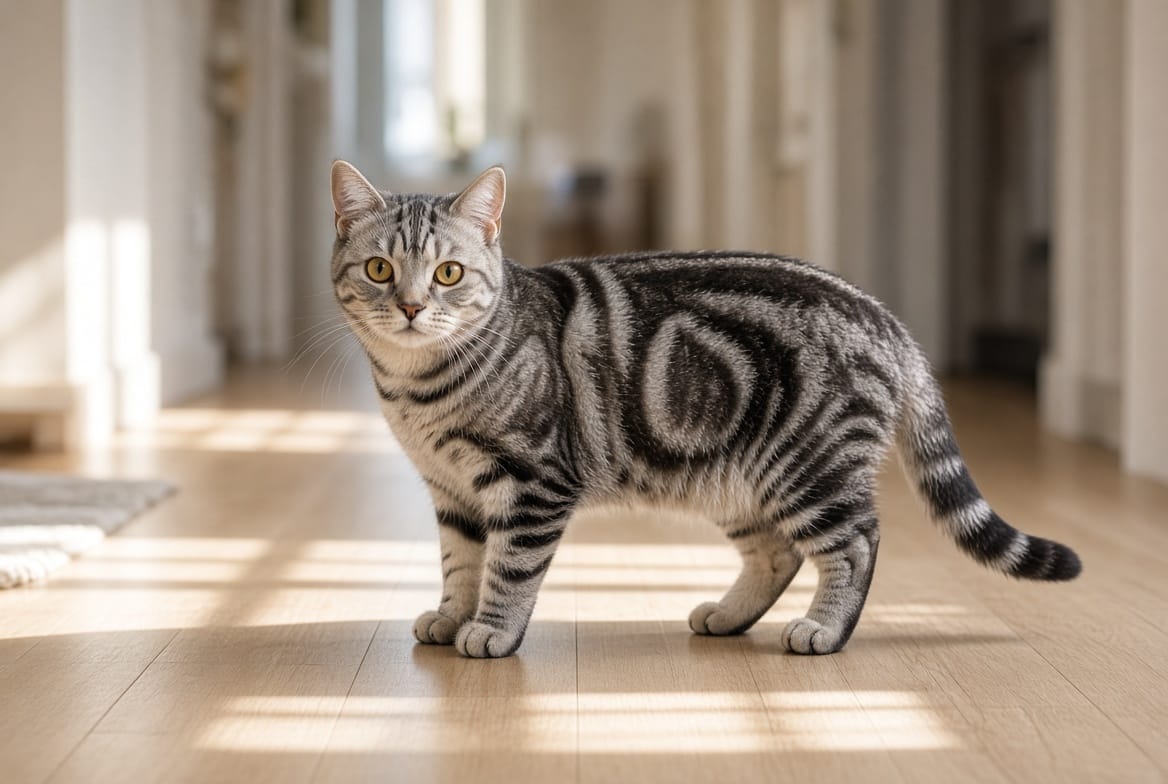
The American Shorthair descends from ordinary working cats carried aboard early European settler ships to North America, where they earned their keep killing rodents on farms and in homes. Cats of this type appeared at the first US cat show in 1895, and the breed was one of the first five recognized by the Cat Fanciers' Association at its founding in 1906, shown as Domestic Shorthairs until it was given its current name in 1965. Because the breed was formalized from a broad random-bred foundation rather than a small founder group, it kept comparatively good genetic variation: in the largest genetic survey of cat breeds, its observed heterozygosity measured 0.57 against a purebred average of 0.51 and a random-bred average of 0.65. The CFA standard is explicitly anti-extreme, requiring that no part of the anatomy be so exaggerated as to foster weakness, and it lists obesity as a fault. The breed's real risks are cardiac and metabolic rather than structural: it is named among those predisposed to hypertrophic cardiomyopathy, and a placid, food-motivated indoor cat is an easy cat to overfeed.
📋 Quick Facts
Native Range
Breed origin: United States (working ships' and farm cats of early European settlers, formalized by the Cat Fanciers' Association in 1906 and renamed in 1965)
Natural Habitat
Fully domesticated
Adult Size
Medium to large and muscular, slightly longer than tall; 6-15 lbs, males at the heavier end
Wild Diet
Fully domesticated
Wild Lifespan
15-20 years (UK primary-care life tables put life expectancy at birth for all cats at 11.7 years)
Conservation Status
Not applicable (domesticated breed)
📜 History
The first cat entered in the breed's records was born in England. Champion Belle of Bradford, a red tabby male born in 1900 and imported to the United States, opened the registry for a breed otherwise built on American working cats. The name moved around before it settled: the cats were shown simply as Shorthairs at first, then relabeled Domestic Shorthair around 1930 to mark them off from imported British stock. That change backfired, because it made a pedigreed animal sound like any stray, and by 1961 breeders were campaigning for a name that claimed the continent instead.
⚖️ Compare
American Shorthair
Human
Adult Size
Medium to large and muscular, slightly longer than tall; 6-15 lbs, males at the heavier end
5-6 feet (150-185 cm); ~135-200 lbs
Wild Lifespan
15-20 years (UK primary-care life tables put life expectancy at birth for all cats at 11.7 years)
~73 years (global average)
Wild Diet
Fully domesticated
Omnivorous - eats just about anything
Native Range
Breed origin: United States (working ships' and farm cats of early European settlers, formalized by the Cat Fanciers' Association in 1906 and renamed in 1965)
Global - originated in Africa roughly 300,000 years ago
Natural Habitat
Fully domesticated
Everywhere from arctic tundra to tropical megacities
Conservation Status
Not applicable (domesticated breed)
Least Concern (8+ billion and counting)
🧠 Test Yourself
What's the American Shorthair's native range?
Subscribe - it's free
New animal facts and care guides straight to your inbox. No spam. 🐾
🩺 Health and More
🐈 Cat Enrichment: Five Pillars, and Most Homes Miss the Second One
🧬 What a Pet DNA Test Actually Tells You
🫘 Kidney Disease in Cats: What the Numbers Actually Mean
🫀 Cardiomyopathy in Cats and Dogs: HCM, DCM and What They Mean
⚖️ Body Condition Score: How to Tell if Your Pet Is Actually Overweight
🐱 Why Cats Need Mental Enrichment (And How Boredom Can Break Them)
🤓 Did You Know?
For a pedigree cat, the American Shorthair is remarkably outbred. In the largest genetic survey of cat breeds its observed heterozygosity measured 0.57, above the purebred average of 0.51 and closer to random-bred cats at 0.65 than to bottlenecked breeds such as the Singapura, which came in at 0.34.
Explore More