Rottweiler
Canis lupus familiaris
On This Page▾
🌍 Overview
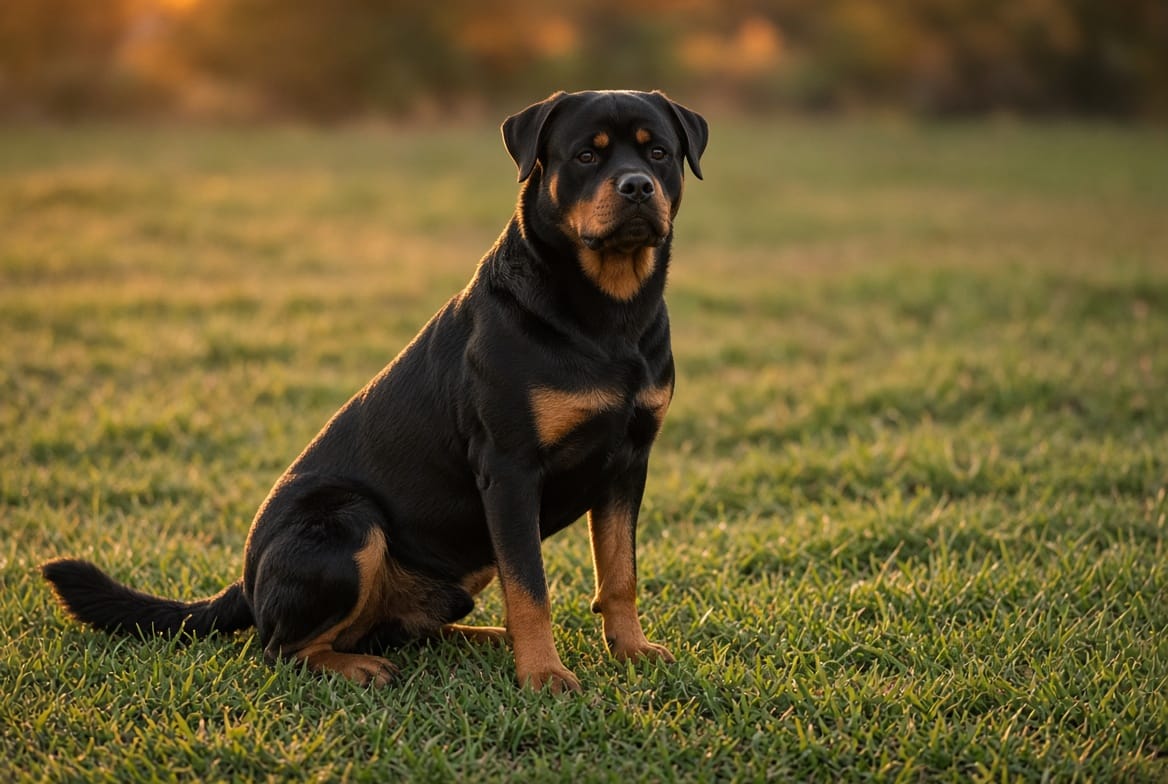
The Rottweiler descends from Roman drover dogs bred to move and guard the herds that fed the legions. After the empire's collapse the type found work in the German cattle town of Rottweil and earned the name Rottweiler Metzgerhund, the Butcher's Dog of Rottweil. When railroad cattle cars ended the droving trade in the 1800s the breed was redirected into police work, personal protection and guide work, and the AKC admitted it to the Stud Book in 1931. Selecting for great mass and bone has come at a measurable orthopedic cost: OFA data from 1974 to 2015 record 20.2 percent of Rottweilers as hip dysplastic and 36.7 percent as elbow dysplastic, against Labrador figures of 11.5 and 10.2 percent. The same size and long bone length carry an extreme bone cancer burden, with Rottweilers showing 26.67 times the odds of osteosarcoma compared with crossbred dogs in a UK study of 905,552 dogs. Median longevity in UK primary care is 9.0 years, with cancer the single largest cause of death at 33.0 percent, so a buyer should plan for a shorter life and a higher cancer probability than the breed's power and vigor suggest.
📋 Quick Facts
Native Range
Breed origin: Germany (Roman drover and guard dogs redeveloped as the Butcher's Dog of Rottweil, later police and protection work; AKC Stud Book 1931)
Natural Habitat
Fully domesticated
Adult Size
Males 24-27 inches at the shoulder and 95-135 lbs; females 22-25 inches and 80-100 lbs
Wild Diet
Fully domesticated
Wild Lifespan
9-10 years (UK primary-care data give a median longevity of 9.0 years, 9.5 for females and 8.7 for males)
Conservation Status
Not applicable (domesticated breed)
📜 History
The breed came close to disappearing at the turn of the twentieth century, and the recovery was closer to a rescue. By 1905 a single female was reported left in the town of Rottweil itself. Fanciers organized fast: the International Club for Leonberger and Rottweiler Dogs produced a first standard in 1901, the Deutscher Rottweiler Klub was founded in January 1907, and in 1910 the German police service accepted the Rottweiler as its fourth approved breed. The rival clubs merged into the Allgemeiner Deutscher Rottweiler Klub in 1921, with a third joining in 1924, and that body has written the breed's breeding rules ever since.
⚖️ Compare
Rottweiler
Human
Adult Size
Males 24-27 inches at the shoulder and 95-135 lbs; females 22-25 inches and 80-100 lbs
5-6 feet (150-185 cm); ~135-200 lbs
Wild Lifespan
9-10 years (UK primary-care data give a median longevity of 9.0 years, 9.5 for females and 8.7 for males)
~73 years (global average)
Wild Diet
Fully domesticated
Omnivorous - eats just about anything
Native Range
Breed origin: Germany (Roman drover and guard dogs redeveloped as the Butcher's Dog of Rottweil, later police and protection work; AKC Stud Book 1931)
Global - originated in Africa roughly 300,000 years ago
Natural Habitat
Fully domesticated
Everywhere from arctic tundra to tropical megacities
Conservation Status
Not applicable (domesticated breed)
Least Concern (8+ billion and counting)
🧠 Test Yourself
What's the Rottweiler's native range?
Subscribe - it's free
New animal facts and care guides straight to your inbox. No spam. 🐾
🩺 Health and More
🐕 Dog Enrichment: Let Them Sniff, and the Dog Gets More Optimistic
🧬 What a Pet DNA Test Actually Tells You
👁️ Inherited Eye Disease: What Screening Actually Catches
🦴 Hip and Elbow Dysplasia: What the Grades Actually Mean
⚖️ Body Condition Score: How to Tell if Your Pet Is Actually Overweight
🐶 Bloat in Dogs: The Emergency Every Large-Breed Owner Should Know
🤓 Did You Know?
Despite the guarding reputation, Rottweilers were among the first dogs used as guide dogs for the blind, and in more recent decades they worked search and rescue at the Oklahoma City bombing and the World Trade Center disaster sites.
Explore More